

















Introduction
Continuous improvement in manufacturing often depends on innovations that streamline processes and enhance reliability. Even small enhancements in equipment handling can deliver significant gains in productivity, safety, and cost efficiency. The development of an in‑house Auto Coupler for fixture changeovers exemplifies this principle. By integrating automation into routine operations, the initiative reflects how practical engineering ingenuity can transform everyday challenges into opportunities for operational excellence. This Kaizen highlights the concept, implementation, and benefits of the Auto Coupler system, showcasing its role in advancing efficiency and quality standards within fabrication environments.
Problem Description
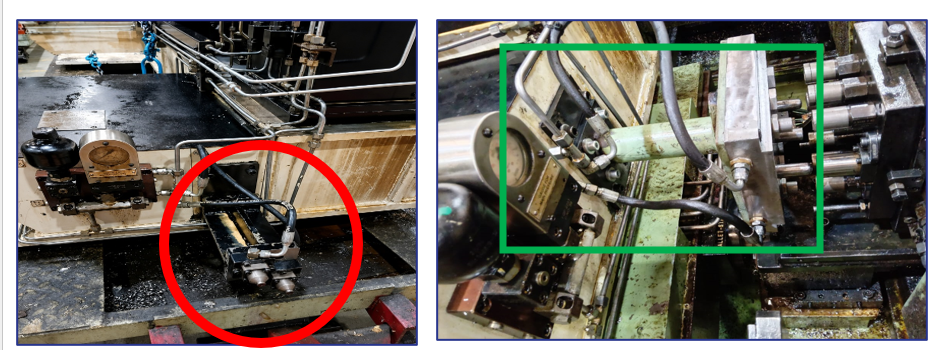
At one of the heavy equipment manufacturing sites, fixture changeovers between the specialized Power Boom and standard Power Boom were essential to meet diverse production requirements. However, the existing process relied on manual disconnection and reconnection of hydraulic pipes. This approach was not only slow but also prone to inefficiencies. Each changeover consumed 180–240 minutes, required 2–3 operators, and often led to hydraulic oil leakage. The manual handling of hoses posed safety risks during connection and disconnection, while extended downtime reduced daily output and machine availability. In short, the lack of a quick‑change system created a recurring bottleneck that directly impacted productivity and reliability.
Solution
To address these challenges, the Fabrication Maintenance team took an innovative approach by designing and implementing an in‑House Auto Coupler System. This system enabled automatic hydraulic connections during fixture changeovers, eliminating the need for manual intervention.